

From Gnutella to the Browser Tab: How File-Sharing Architecture Quietly Consolidated
From Gnutella to the Browser Tab: How File-Sharing Architecture Quietly Consolidated
File sharing did not become simpler because the underlying problem got easier. It became simpler because the layer where the complexity lives moved — first from the user's desktop into a handful of unifying client applications, and later from the desktop entirely into the browser and the server infrastructure behind it. This article traces that architectural migration, from the fragmented protocol landscape of the early 2000s through the multi-protocol client era to the clientless HTTP/S transfer platforms in common use today.
Section 1: The Fragmentation of Early P2P Networks (1999–2005)
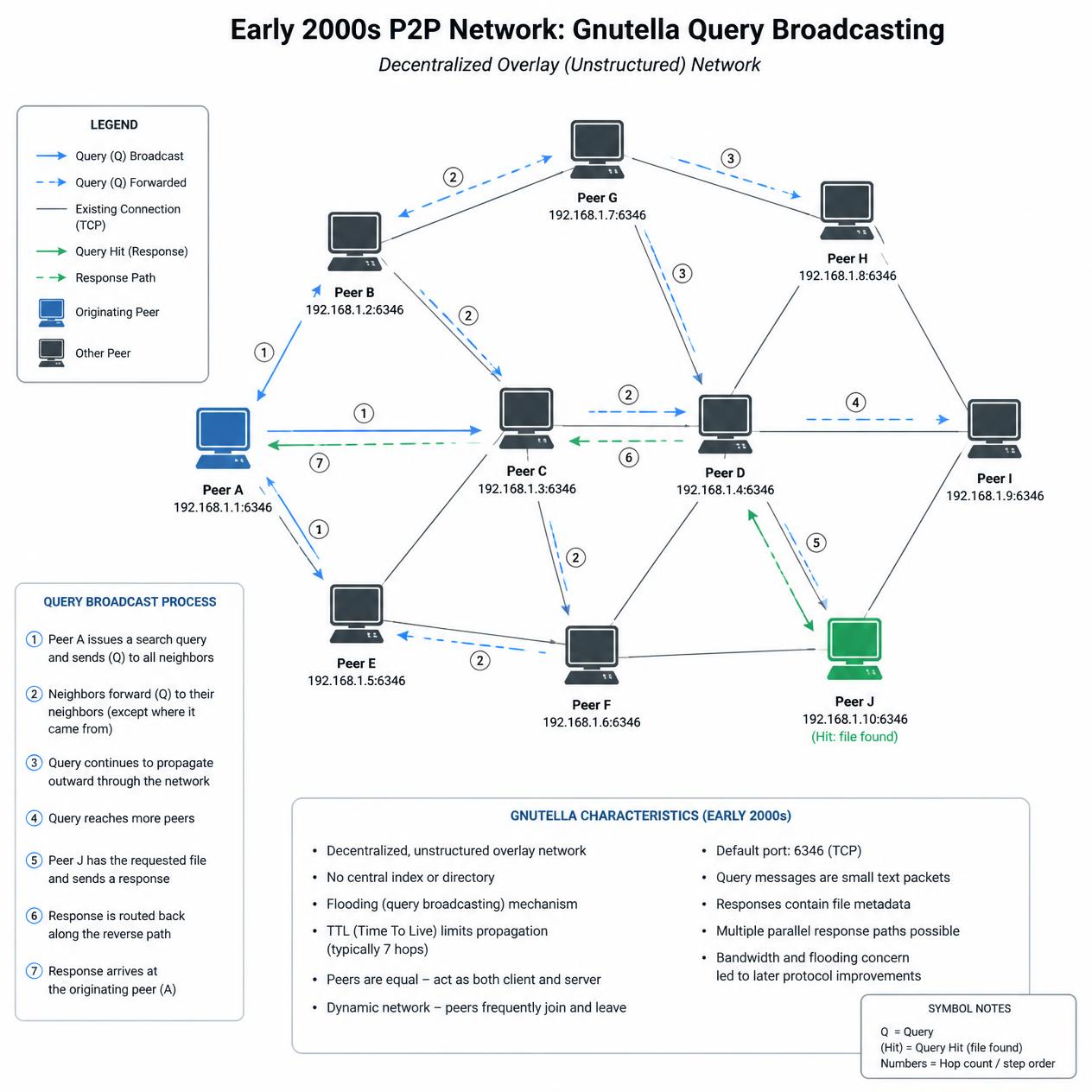
The first wave of mainstream peer-to-peer file sharing was defined less by any single technology than by a proliferation of incompatible ones. Gnutella, launched in 2000, used a flooded query broadcast model across an unstructured overlay network: a search request propagated outward from peer to peer up to a fixed time-to-live hop count, with no central index. This made Gnutella resistant to a single point of failure but notoriously inefficient at scale, since query traffic grew combinatorially with network size — a problem that later Gnutella implementations partially addressed with ultrapeer/leaf hierarchies.
eDonkey2000, released the same year, took a different approach. It relied on semi-centralized servers that indexed file availability and coordinated peer discovery, while the actual transfer occurred directly between clients. Crucially, eDonkey introduced the MD4-based hash-tree identification scheme (later refined in eMule as the MD4 "eD2k hash"), which let the network identify identical files across a swarm regardless of local filename, and enabled corrupt-chunk detection during multi-source downloads.
FastTrack, the protocol behind Kazaa and early Grokster, used a supernode architecture: ordinary peers with sufficient bandwidth were automatically promoted to relay search traffic for a cluster of leaf nodes, reducing the load a flat Gnutella-style network would have generated. FastTrack was also proprietary and encrypted at the protocol level, which made independent interoperability difficult and eventually motivated reverse-engineering efforts by clients such as Kazaa Lite and, later, giFT.
The practical consequence for an end user in this period was operational friction. A person searching for content across all three ecosystems needed three separate client binaries, each maintaining its own listening port, its own NAT traversal behavior, its own bandwidth throttling settings, and — because none of these networks spoke to each other — three entirely separate search indices with no overlap. Running LimeWire, an eDonkey client, and a FastTrack client simultaneously was common but wasteful: each process maintained its own connection table, its own partial-file cache, and its own firewall exceptions, and none of that state was shared.
Section 2: The Multi-Protocol Adaptation Era (MLDonkey & Shareaza)
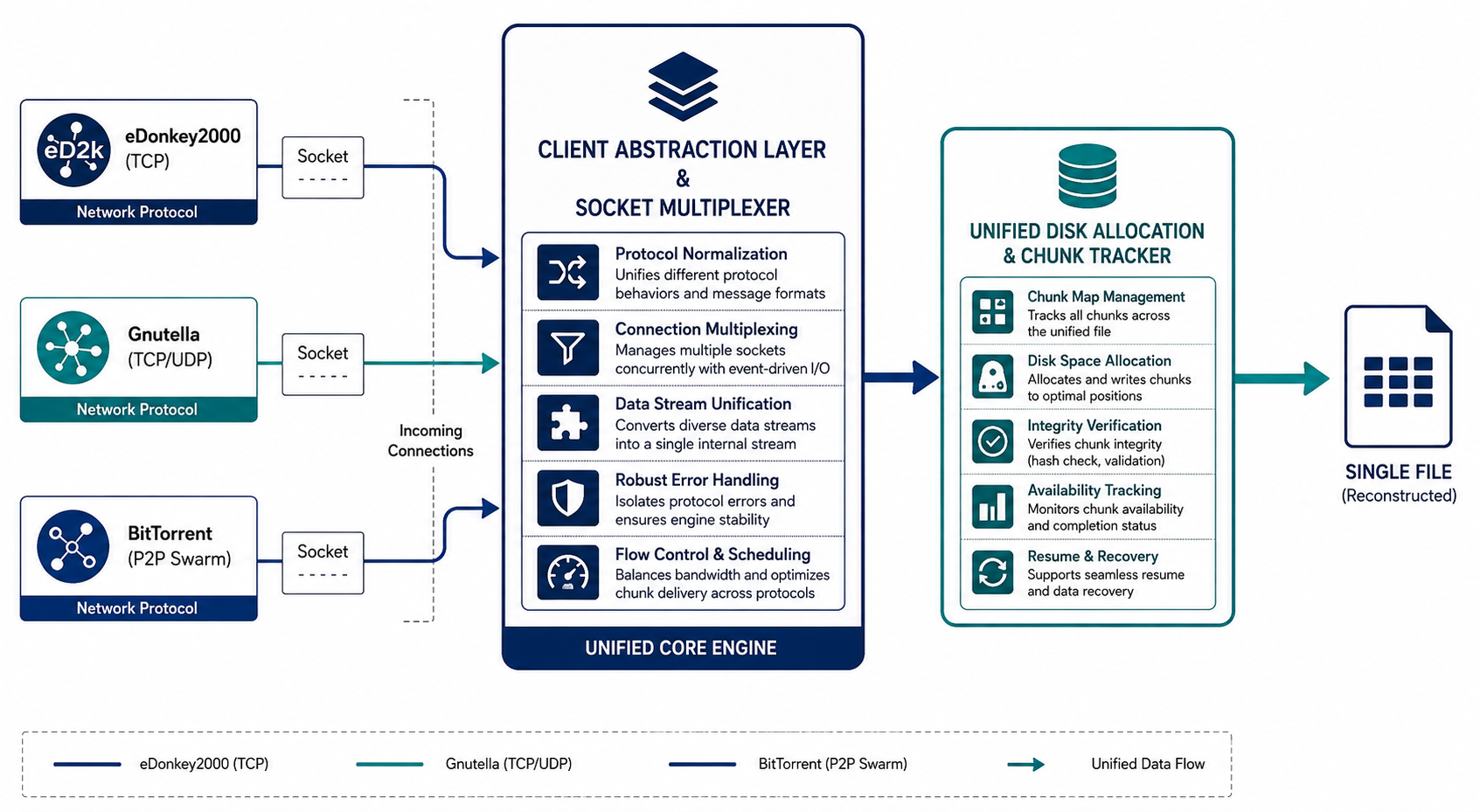
The client fragmentation problem was solved not by protocol convergence — Gnutella, eDonkey, and FastTrack never merged into a single wire format — but by abstraction at the client layer. MLDonkey, first released in 2001 and developed primarily in OCaml, and Shareaza, a Windows-native client, both took the approach of implementing multiple protocol stacks inside a single process and presenting the user with one unified search and download interface.
The engineering challenge here was nontrivial. Each network required its own socket-handling logic: eDonkey servers spoke a binary TCP protocol with fixed-size packet headers, Gnutella used a text-and-binary hybrid descriptor format propagated over both TCP and, in later revisions, UDP for connectionless queries, and FastTrack's encrypted handshake had to be independently derived from observed traffic. MLDonkey's architecture handled this by running protocol-specific modules concurrently, each maintaining its own connection pool and peer state machine, while a shared core managed the local file table, disk I/O, and the user-facing queue.
Multiplexing was the second half of the problem. A single logical download — say, a Linux ISO — might be sourced simultaneously from eDonkey peers, Gnutella peers, and, if the client supported it, BitTorrent peers, all writing into overlapping byte ranges of the same file on disk. This required a chunk-tracking layer independent of any one protocol's native addressing scheme, reconciling differing block sizes (eDonkey's 9,728,000-byte parts versus BitTorrent's typically much smaller piece sizes) against a single local file allocation table.
The third piece was hash unification. Because eDonkey identified files by an MD4-based hash and BitTorrent identified them by a SHA-1 info-hash over its own piece layout, a multi-protocol client had no native way to know that a file arriving from one network was identical to a file already partially downloaded from another. MLDonkey and Shareaza both addressed this heuristically — by filename and file size correlation, and in some cases by computing and cross-referencing multiple hash types for the same local file — rather than through any protocol-level bridging, since the hash algorithms themselves were not interoperable. This is a meaningful nuance often lost in casual accounts of "protocol bridging": what these clients unified was the user experience and local file management, not the underlying cryptographic identity schemes, which remained protocol-specific.
The net effect was still substantial. A user running Shareaza no longer needed separate installations, separate port-forwarding rules, or separate firewall exceptions for each network. One process, one listening port range, one download queue — with the protocol complexity absorbed into the client rather than imposed on the user.
Section 3: The Shift to Modern Browser-Native Utility Platforms
The more consequential architectural shift came later, and it did not involve adding a fourth or fifth protocol to a multi-protocol client. It involved removing the client altogether. Modern file-transfer utilities — from simple drag-and-drop upload-and-share tools to more elaborate collaborative platforms — increasingly operate entirely inside the browser, using HTTP/S as the sole transport layer and JavaScript running in the page context to perform work that previously required a compiled desktop binary.
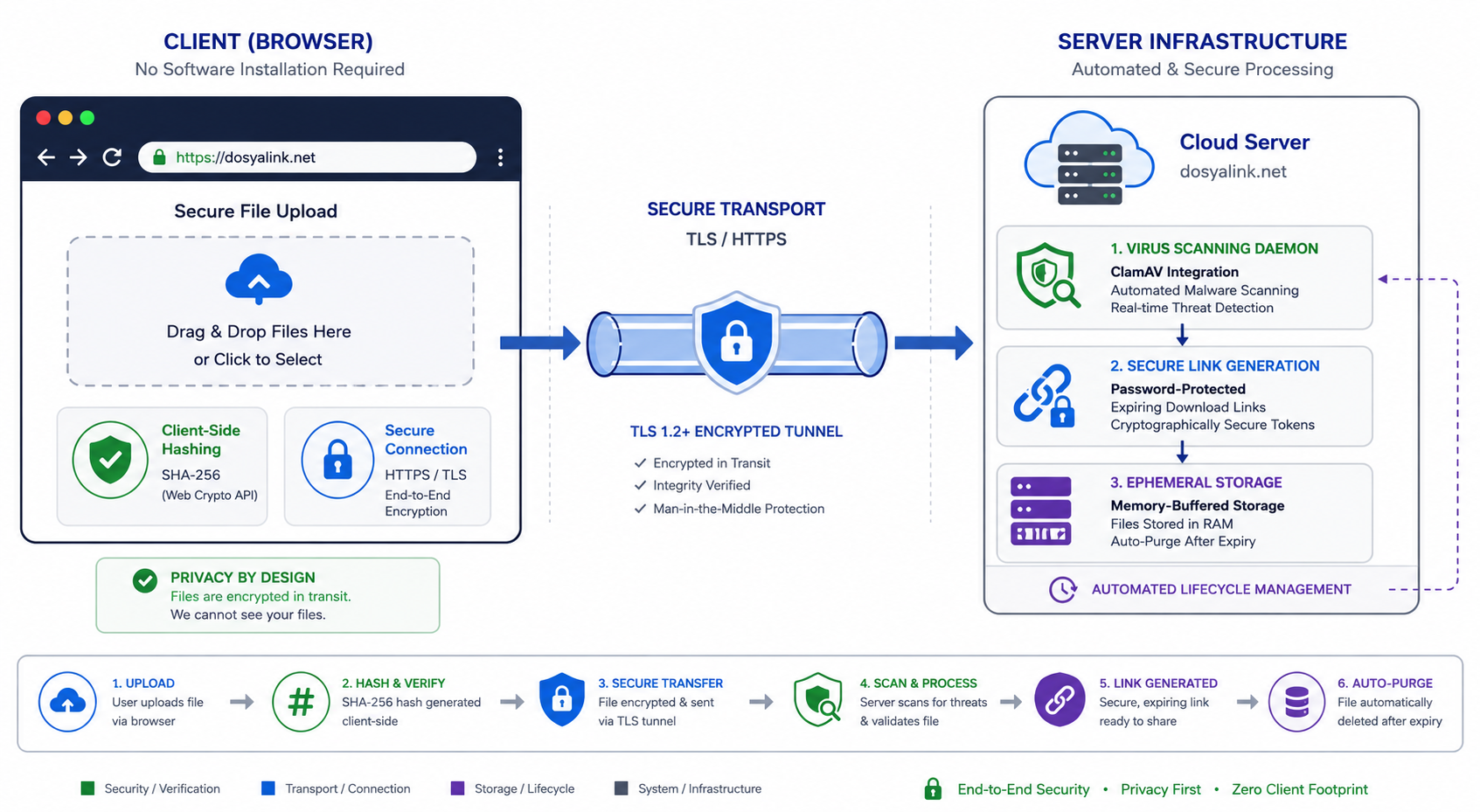
Several technical developments made this viable. Client-side cryptographic hashing, using the Web Crypto API's SubtleCrypto.digest() implementation of SHA-256, lets a browser compute a file's integrity hash before or during upload without sending the raw bytes to a separate hashing service or trusting a server-reported checksum. This is meaningfully different from the eDonkey-era model, where hash computation happened during the transfer itself and was tied to a specific network's addressing scheme; here the hash is a general-purpose integrity and deduplication primitive, independent of any transport protocol.
Security inspection moved from being optional and client-side (an eMule user manually scanning a downloaded file with a local antivirus signature set they were responsible for updating) to being mandatory and server-side. A typical modern upload pipeline pushes the file through a server-hosted scanning daemon — ClamAV integration is common in open-source implementations — before the file is ever made available for download, rather than trusting the recipient to scan it after the fact. This shifts the security burden away from the end user's local configuration and onto infrastructure the service operator controls and updates.
Ephemeral handling of file content is another structural difference from the P2P era. Where eDonkey and BitTorrent clients were built around long-lived partial-file caches on local disk — by design, since swarm-based transfer assumes a file may take hours or days to complete — many browser-native transfer tools are built around short-lived server-side storage, sometimes holding file content only in memory buffers for the duration of an active transfer session, with automatic expiration rather than indefinite local retention. Combined with password-protected, time-limited share links, this produces a fundamentally different threat model: exposure window is bounded and configurable per transfer, rather than open-ended for as long as a peer keeps seeding.
Finally, the P2P-era requirement for correct firewall and NAT configuration — forwarding a specific inbound port so other peers could connect back to your client — has largely disappeared. Browser-native transfer is built on outbound HTTPS requests to a known server, which traverses essentially any consumer firewall or NAT configuration without user intervention, at the cost of reintroducing a centralized point of control that decentralized P2P architectures were explicitly designed to avoid.
Section 4: Technical Comparison
| Dimension | Early Multi-Protocol P2P (MLDonkey / Shareaza) | Modern Browser-Native Platforms |
|---|---|---|
| Protocol architecture | Multiple concurrent protocol stacks (Gnutella, eDonkey, FastTrack, BitTorrent) unified at the client application layer; no protocol-level bridging | Single HTTP/S transport layer; all functionality implemented as client-server web requests |
| Installation requirements & overhead | Dedicated desktop binary install, persistent background process, local partial-file cache, manual port-forwarding/NAT configuration | None; runs in-browser via JavaScript, no installation, no port configuration |
| Security inspection | Client-side and optional — user-managed antivirus scanning after download completes | Server-side and typically mandatory — automated scanning (e.g., ClamAV daemon integration) before a file is made available |
| File integrity verification | Protocol-specific hashing (MD4-based eD2k hash, BitTorrent SHA-1 info-hash), not cross-compatible between networks | Client-side SHA-256 via Web Crypto API, computed independently of any specific transfer protocol |
| Network dependency & firewall traversal | Requires stable inbound connectivity; correct port forwarding materially affects download speed and peer reachability | Outbound-only HTTPS; traverses standard consumer firewalls and NAT without configuration |
| Data persistence model | Long-lived local partial-file cache, indefinite seeding/retention at user discretion | Often ephemeral server-side storage with configurable expiration; bounded exposure window |
| Access control | Network-level visibility to any connected peer; limited built-in access restriction | Password-protected, expiring share links; per-transfer access control |
Section 5: Conclusion & Future Outlook
The trajectory described here is not one of file sharing becoming inherently less complex — the volume of data moved, the integrity guarantees expected, and the security scrutiny applied have all increased substantially since 2000. What changed is where that complexity is managed. Early P2P networks pushed protocol diversity onto the user, who ran and configured multiple clients. The multi-protocol client era absorbed that diversity into a single application, unifying the user experience without unifying the underlying protocols themselves. The current browser-native era goes a step further, moving both the protocol handling and much of the security inspection off the local machine entirely, onto server infrastructure reachable over a single, firewall-agnostic transport layer.
This consolidation has trade-offs that are worth stating plainly rather than glossing over. Centralized, server-mediated transfer reintroduces dependency on a single operator's infrastructure and policies, in contrast to the operator-independent resilience that decentralized swarm-based networks were built to provide. Whether the field continues toward increasingly centralized, browser-native utility platforms, or sees a partial resurgence of decentralized architectures — for instance through peer-to-peer WebRTC data channels operating without a traditional installed client — will likely depend on how the industry balances user convenience against the resilience properties that made the original P2P model worth building in the first place.